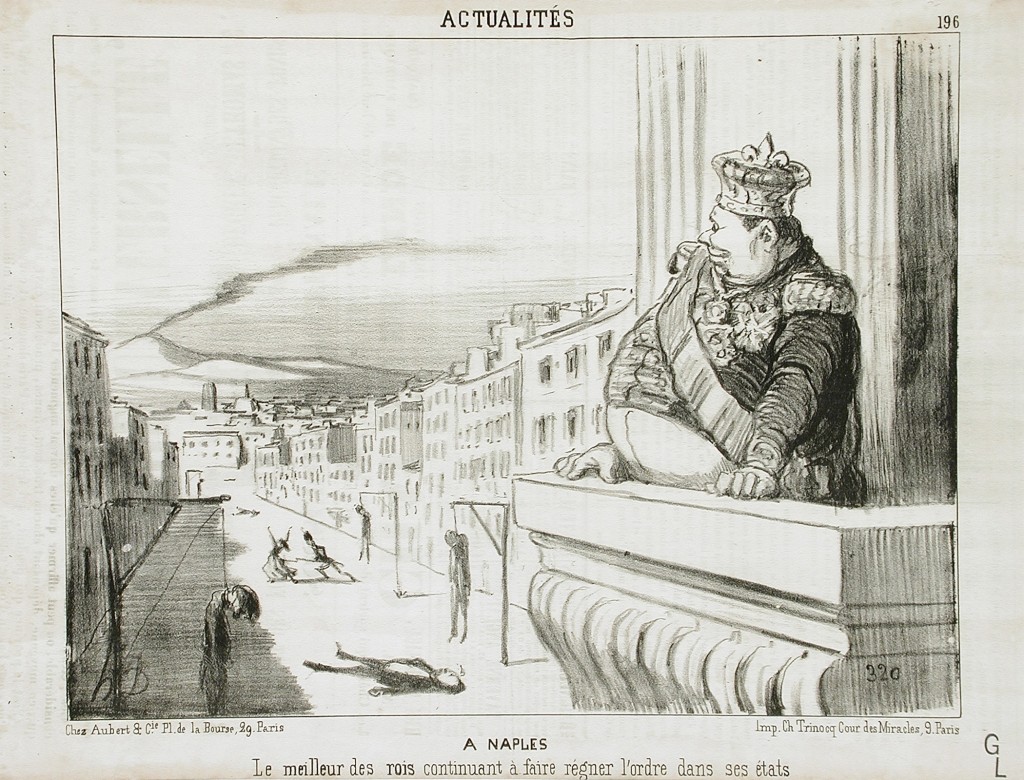
Honoré Daumier – Le meilleur des rois continuant a faire regner l’ordre dans ses etats (The best of kings continuing to keep order in his states), 1851
Political speech is the core expressive activity that forms the foundation of our democracy; it receives the highest level of protection under the First Amendment. This protection includes art used in a political context, which covers everything from protest art to logos commissioned by political campaigns. It also protects art that contains political aspects but has no clear political message, such as art that lampoons a public figure for the way they dress (which might also be considered parody).
In general, the First Amendment protects art with a political aspect unless it is found to be obscene or defamatory. Additionally, political art that can be characterized as “extremist” because of its violent message or support for a group that advocates violence may be subject to restrictions on hate speech or true threats. Finally, even where “extremist” statements in art cannot be prohibited or punished, artists should be aware that such expressions and associations with known “extremist” groups may subject them and their online activity to law enforcement surveillance without violating the First Amendment. An artist might still run into some issues with political if they seek to profit from using a political figure’s image, or if their speech is of a type regulated by campaign finance laws. We discuss political figures’ privacy and publicity rights in our section on depictions of real people, and devote this section to campaign finance law.
Campaign finance laws govern the money that politicians spend to advertise and support their candidacy. Campaign finance laws and freedom of expression can collide when regulations of campaign contributions limit the ability of a party to express their beliefs. In some cases, artists may need to be aware of how those restrictions impact the use of their art, especially if the art is created in support of a specific candidate.
This area of law is generally not an issue for artists since campaign finance laws are focused on accounting for the money spent on a campaign, and not what private citizens say about the campaign. But, if you create art that is related to a specific candidate or campaign, you should be aware of the ways that campaign finance law may restrict what you say and how you say it. Federal laws govern federal elections while state laws govern state elections, and there may be some discrepancy between the two sets of laws as to what is allowed.
The Basics
Federal campaign finance law exempts many Internet-based political activities under an “uncompensated Internet activity” exemption from reporting requirements. This exemption covers activities including, but not limited to, “sending or forwarding electronic messages; providing a hyperlink or other direct access to another person's Web site; blogging; creating, maintaining, or hosting a Web site; paying a nominal fee for the use of another person's Web site; and any other form of communication distributed over the Internet.” Most political activity that artists engage in online will likely be covered by this exception.
One instance when an artist might need to examine campaign finance law more closely is when he or she has created art that is used in a political advertisement. Essentially, the key question is whether the advertisement advocates for an issue or promotes the election or defeat of a specific candidate. The first part of an inquiry by the Federal Election Commission is to see whether the advertisement clearly identifies a candidate. According to the FEC, a “clearly identified candidate” is one whose “name, nickname, photograph, or drawing appears, or whose identity is apparent through unambiguous reference, such as ‘your Congressman,’ or through an unambiguous reference to his or her status as a candidate, such as ‘the Democratic presidential nominee’ or ‘Republican candidate for Senate in this state.’”
The second question, and the one that’s most important to an artist, is whether the art is intended for “public communication,” a term that has a special meaning in the Internet context. Generally, a public communication is the broadcast of a message with the intent to reach a large audience. Art (and its associated costs) that is created in support of such a communication must be reported as a campaign contribution to the FEC. Fortunately, art posted only on the Internet is not considered a public communication unless it is placed on another person’s website for a fee – that is, if the artist pays another website to post his art as an advertisement. Artists who create art about a political campaign and post it on their own website or blog, or on a free art- or photo-sharing website, should generally find that their art falls under the “uncompensated Internet activity” exemption.
Artists are free to post art on their own website, or free art-sharing sites, that supports the election or defeat of a candidate without any obligation to report the costs.
On the other hand, if you create art that calls for the election or defeat of a specific candidate and also pay to have your art posted on a third party’s website (most commonly in the form of an advertisement), federal election law requires clear disclaimers that include your name and address. The same disclaimers must also be included if the art is posted as a paid advertisement to solicit contributions for a candidate.
Any money spent on Internet advertisements that supports election or defeat of a candidate is considered a campaign contribution – no matter how low the cost.
If the amount spent is over $250, it must be reported to the Federal Election Commission. So, if you create a design that clearly supports the election of a candidate and pay to post that art on a website for an event, that money is a considered a contribution, and may need to be reported.
In 1971, Congress passed the Federal Election Campaign Act to regulate contributions to elections to federal office. Two Senators filed suit, claiming the Act was unconstitutional. The Supreme Court held that campaign finance regulations are not allowed to restrict freedom of speech. Thus, the law could impose limits on the contributions made by individuals to a particular campaign, but expenditures by individuals or groups that merely express support of a candidate could not be limited in the same way.
The Wisconsin Right to Life (WRL), a nonprofit political action committee, sponsored advertisements urging voters to contact two senators to filibuster judicial nominees. The McCain-Feingold Bipartisan Campaign Reform Act of 2002 (BCRA) prohibited the use of corporate funds for political advertisements that aired within 60 days of an election. WRL sued the Federal Election Commission, claiming BCRA was unconstitutional. The Supreme Court agreed, finding that provision of BCRA a violation of the First Amendment as applied to advertisements that do not endorse or oppose a particular candidate. Thus, “issue advertisements” may be aired within 60 days of an election.
In this recent case, the non-profit organization Citizens United challenged the BCRA provision that prohibits corporations from making “electioneering communications” within 30 days of a primary election. Citizens United produced a 90-minute film entitled “Hillary: the Movie,” a documentary that was highly critical of then-presidential candidate Hillary Clinton. The group received money directly from corporations to make the film and thus violated Section 203 of BCRA, which prohibits the use of corporate treasury funds to release candidate-specific communications close to an election. Citizens United challenged the constitutionality of this provision, contending that the limits on corporate support violated the First Amendment.
The Court agreed with Citizens United, holding that Section 203 placed an unconstitutional restriction on corporations’ right to free speech. While the Court upheld federal laws prohibiting corporate contributions made directly to candidates’ election campaigns, it held that corporate funding used to produce speech – including films, commercials, books, and other printed material – is a protected form of political speech. The Court’s decision has been criticized, and proposals have been made in Congress to respond to this decision.
Other Resources